Walk into almost any building, and the air feels fine. No obvious smoke. No strong odors. Yet measurements often tell a different story. Fine dust lingers, volatile organic compounds drift off furnishings, and biological contaminants circulate quietly. Indoor air pollution rarely announces itself.
That gap between perception and reality explains why many people turn to a CADR calculator when choosing an air purifier. It offers numbers, clarity, and a sense of control. Still, confusion sets in fast. Two devices show similar CADR ratings but behave very differently in real spaces.
While CADR helps size air purifiers, not all technologies handle ultrafine particles, VOCs, or biological contaminants equally. That distinction matters more than most buying guides admit, and it is where advanced systems like CleanAirZone begin to differ, quietly and without spectacle.
What CADR Is and Why It Became the Standard
CADR stands for Clean Air Delivery Rate. It measures how quickly an air purifier removes a specific category of particles from a room. Typically, those categories include smoke, dust, and pollen.
The appeal is obvious. Higher numbers suggest faster cleaning. A larger room demands a higher CADR.
Yet CADR reflects airflow efficiency tied to particle filtration, not total air quality. Gases, chemical fumes, and microorganisms fall largely outside its scope. Even particle size matters. CADR testing focuses on particles far larger than many of the pollutants associated with respiratory irritation or long term exposure.
CADR still matters. It just does not tell the whole story.
How a CADR Calculator Estimates Room Needs
A CADR calculator works by combining room dimensions with recommended air changes per hour. Most models assume two to five complete air exchanges each hour.
A quick example. A 200 square foot room with standard ceiling height may need a CADR of roughly 130 to 150 to keep particulate levels under control. Larger rooms scale upward quickly.
This approach suits conventional room air purifier selection. It ensures the fan can circulate air fast enough for filters to do their job. What it cannot assess is what happens after pollutants are captured, or whether certain contaminants are addressed at all.
For shoppers comparing the best air purifier options, the calculator is a starting point, not a verdict.
Where CADR Falls Short in Real Environments
Air is not just dust and pollen. It carries combustion byproducts, cleaning chemicals, microbial fragments, and in some settings, live bacteria or viral particles.
CADR does not evaluate how an air purifier handles VOCs. It does not reflect ongoing bacterial load reduction. It also ignores what happens when filters become colonized over time, a known limitation in some systems.
So while CADR helps size equipment, it may underrepresent technologies designed to neutralize pollutants rather than simply trap them.
Technology Matters Beyond CADR Metrics
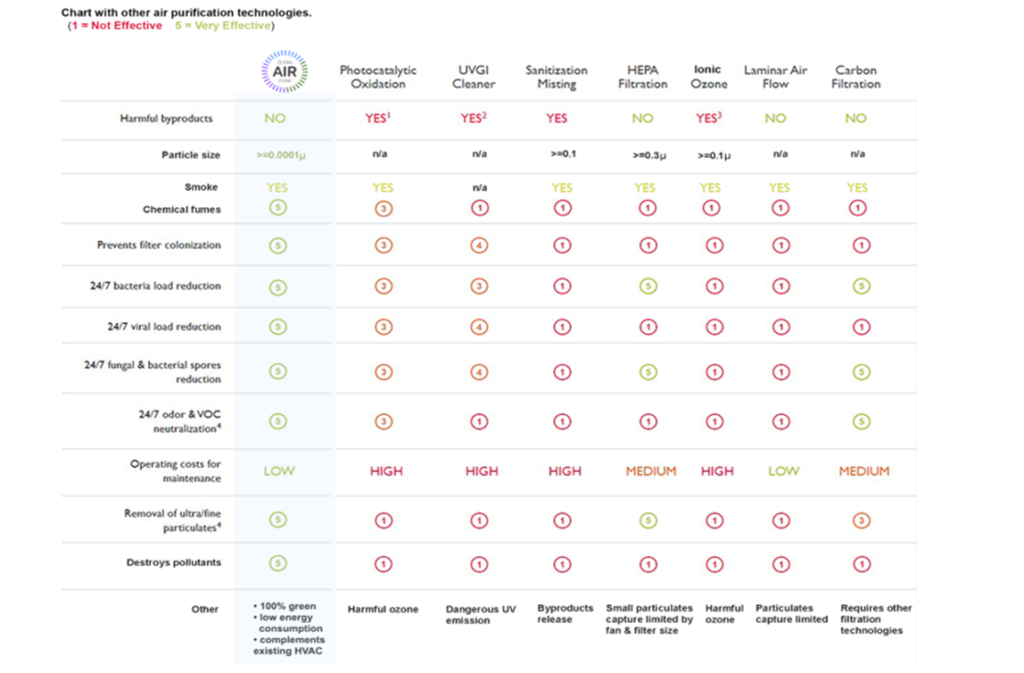
CADR measures airflow efficiency, but it does not reflect how different purification technologies treat viruses, VOCs, or ultrafine particles. That gap becomes clear when systems are compared side by side.
Across common purification approaches, performance varies widely. Some methods generate harmful byproducts. Others struggle with ultrafine particulates or chemical fumes. Many rely heavily on filters whose effectiveness declines as they load.
Compared across multiple performance metrics, CleanAirZone is one of the few systems that addresses ultrafine particles, biological contaminants, and VOCs simultaneously, without harmful byproducts. That observation is not about superiority claims. It is about coverage.
Independent comparisons show differences in particle size capture, continuous microbial reduction, odor neutralization, and long term operating cost. CADR alone cannot express those variables.
How CleanAirZone Works Beyond Traditional CADR Thinking
CleanAirZone systems operate on a two step process rather than passive filtration alone.
Capturing Pollutants
Airborne particles receive an electrical charge, allowing even ultrafine pollutants to be drawn out of circulation. Sizes down to 0.0001 microns can be addressed, well below typical CADR test thresholds.
Digesting Pollutants
Captured contaminants move into water containing the BioCAZ Solution®, a blend of enzymes and microorganisms developed through decades of research. Pollutants undergo oxidation and biological digestion, leaving no residual waste.
Central to this process is the patented Spiral Flow BioReactor. It maximizes oxygen transfer, reportedly reaching levels up to 120 percent, which supports consistent breakdown of pollutants. System integrity matters here. Replace the BioReactor or BioCAZ Solution®, and performance may drop sharply.
This design shifts the conversation from filter replacement schedules to continuous pollutant destruction.
Where Room Size Ends and Air Quality Begins
For residential spaces, sizing still matters. A bedroom, office, or nursery does not need industrial scale equipment.
Compact systems such as the CAZ Mini are designed for areas up to 200 square feet. From a CADR perspective, that aligns well with typical calculator recommendations. From a functional perspective, it adds continuous biological and VOC remediation without filters, UV bulbs, or ozone.
This is where the CADR calculator and technology selection meet. One defines room scale. The other defines what happens inside that space, hour after hour.
If you are evaluating a room air purifier based purely on CADR, pause and consider what pollutants concern you most. Particulates alone, or something broader.
Choose your air purifier by what it removes, not just how fast it moves air.
Beyond Indoor Air, Briefly
CleanAirZone technology also extends into agriculture, turf management, and sustainability initiatives through BioCAZ applications. Those areas involve soil health, microbial restoration, and reduced chemical dependence.
They are worth exploring separately. For CADR focused discussions, keeping the lens on indoor air avoids dilution.
Final Thoughts on CADR and Choice
CADR calculators simplify decisions, which explains their popularity. They answer one question well. How much air moves through a device?
They do not answer everything else.
Technology choice, pollutant type, and long term performance shape outcomes more than a single number. Clean air is not just about speed. It is about what remains after the fan stops spinning.
That distinction may guide your next decision, or it may simply linger as a question worth asking.
FAQs
What does a CADR calculator actually measure?
It estimates how quickly an air purifier removes certain particles based on room size and airflow.
Is a higher CADR always better?
Not necessarily. Higher CADR improves particulate removal speed but says little about gases or microbes.
Can an air purifier remove VOCs effectively?
Some technologies can. Many filter based systems are limited without specialized processes.
How do I size an air purifier for a bedroom?
Use a CADR calculator for room size, then consider pollutant types and usage patterns.
Is CADR relevant for advanced systems like CleanAirZone?
It helps with sizing, but performance extends beyond what CADR captures.
If you are reassessing how you choose an air purifier, start with the calculator, then look past it.